
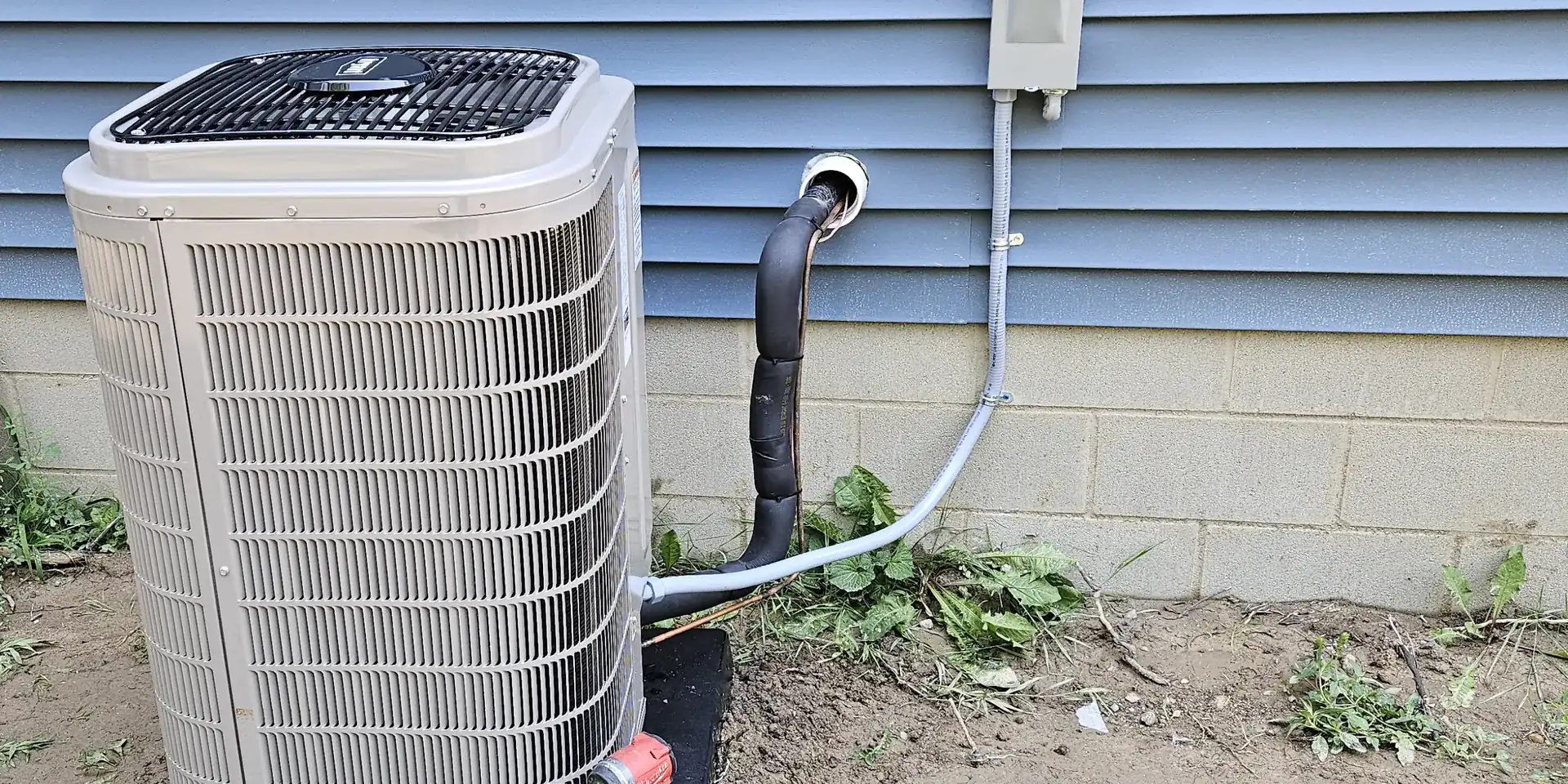
Every fall, as the leaves come down and the first frost hits, homeowners start asking the same question: should the air conditioner outside be covered for the winter? Hardware stores sell covers, neighbors swear by them, and it feels like the responsible thing to do for an expensive piece of equipment sitting out in the snow. The answer is more nuanced than yes or no, and getting it wrong can actually shorten the life of the unit you are trying to protect. Here is how we think about it for homes in Southeast Michigan.
Quick answer
In most cases, you do not need to fully cover an outdoor AC unit for winter. Condensers are built to sit outside year-round, and a full wrap-around cover traps moisture inside and invites mice to nest. A breathable cover over just the top, or a piece of plywood weighted down on top, is reasonable if the unit sits under a roofline that dumps ice and snow or under trees that drop leaves. Keep the sides open and the area around the unit clear.
Your condenser was designed to live outside
The outdoor half of a central air system, the condenser, is engineered to handle rain, snow, sun, and freezing temperatures. Its cabinet is coated steel or aluminum, its electrical components are sealed, and its coil is meant to get wet. It sits through Michigan summers with afternoon thunderstorms and it is built to sit through our winters too. Manufacturers generally do not require a winter cover, and many installation manuals say nothing about one at all.
That does not mean winter is harmless. Ice, falling debris, leaves, and rodents are real risks. The question is whether a cover reduces those risks or adds to them.
Why a full cover often does more harm than good
It traps moisture. A wrap-around vinyl or plastic cover holds in the humidity that collects inside the cabinet. Through freeze-thaw cycles, which we see constantly in a Michigan winter, that trapped moisture condenses on the coil, the fan motor, and the electrical connections and sits there for months. That accelerates rust and corrosion on exactly the parts you were trying to protect.
It makes a perfect rodent shelter. A covered condenser is dry, dark, and protected from wind. Mice and other small animals find it ideal for nesting through the winter, and they chew wiring and insulation while they are there. Rodent damage is one of the more common problems we find at spring startup, and covered units are especially prone to it.
It gets forgotten. If someone switches the air conditioning on during an early warm spell in April or May without removing the cover, the unit runs with no airflow across the coil. Pressures climb, the compressor overheats, and that can cause serious and expensive damage.
When a partial cover makes sense
There are situations where some protection is worthwhile.
Under a roofline without gutters. Ice and snow sliding off a roof, or icicles breaking off the eaves, can bend the top grille or damage the fan blade. If your condenser sits under a drip line, a top cover helps, though moving the unit or adding a gutter is the better long-term answer.
Under trees. In Oakland and Livingston County neighborhoods with mature oaks and maples, a heavy leaf drop can pack the top of the unit with wet leaves, seeds, and twigs that rot over the winter. A top cover keeps that out.
What a good partial cover looks like. A breathable mesh or fabric cover that covers only the top, with the sides left open, or a piece of plywood slightly larger than the top of the unit, weighted with a couple of bricks. Either keeps debris and ice out while letting air move freely through the coil so moisture can escape.
If you have a heat pump, do not cover it at all
This is the most important exception. A heat pump looks almost identical to an air conditioner from the outside, but it runs all winter long, providing heat. Covering it in any way blocks airflow, cripples its heating output, and can damage it. If you are not sure whether your outdoor unit is an air conditioner or a heat pump, check the model number on the label or look at your thermostat for an Emergency Heat or Aux Heat setting, which usually indicates a heat pump. Our article on whether heat pumps work in Michigan winters explains how they operate in the cold.
The same caution applies to ductless mini-split outdoor units, which typically provide heat in winter as well.
How to get your AC ready for winter
Whether you use a top cover or not, a few simple steps help an air conditioner come through winter in good shape.
Clear the area around the unit. Rake leaves, pull weeds, and trim back shrubs so there is about two feet of clear space on all sides. That gives air room to move and gives rodents fewer places to hide.
Rinse off debris. If the coil is visibly clogged with cottonwood, grass clippings, or leaves, rinse it gently from the inside out with a garden hose. Never use a pressure washer on the coil fins.
Turn off power at the disconnect. Most condensers have an outdoor disconnect box mounted on the wall nearby. Switching it off for winter prevents the unit from running on a mild day and protects it if a cover is left on by mistake. Turn it back on about 24 hours before you need cooling in the spring, so the compressor has time to warm up.
Check that the unit is level. A condenser pad that has heaved or settled can stress the refrigerant lines. If the unit is tilting noticeably, mention it at your next service visit.
Keep it clear of snow drifts. A light layer of snow on top does not hurt. But if drifting buries a heat pump, or snow and ice build up against the sides of any outdoor unit, clear it gently by hand or with a broom. Never chip ice off the coil with a shovel or anything sharp.
What to look for in the spring
Before the first hot day, walk out and look at the unit. Remove any cover, clear out leaves and nests, and look for chewed wiring, bent fins, or damage to the top grille. Turn the disconnect back on a day ahead, then run the system and listen for anything unusual. Spring is also the ideal time for an AC tune-up, before the first heat wave, when contractors are busiest. And if your system uses older R-410A refrigerant and is getting up in years, our article on the R-410A phase-out explains what that means for repairs.
Frequently Asked Questions
Is it bad to cover your AC unit in the winter?
A full wrap-around cover can be harmful because it traps moisture against the coil and electrical parts and gives rodents a place to nest. A breathable cover over only the top, with the sides open, is fine if your unit sits under a roofline or trees.
Should I cover my heat pump in the winter?
No. A heat pump runs all winter to heat your home and needs open airflow around it. Covering it reduces its heating output and can damage the equipment. Keep it clear of snow and ice instead.
Can snow damage an outdoor AC unit?
Normal snowfall does not hurt an air conditioner. The risks are ice and heavy snow sliding off a roof onto the unit, and ice buildup against the sides. Clearing it gently by hand or with a broom is all that is needed.
Should I turn off the power to my AC in the winter?
Turning off the outdoor disconnect is a good idea for a cooling-only air conditioner. It keeps the unit from running on a warm winter day. Turn it back on about 24 hours before you use the AC in spring. Never turn off power to a heat pump in winter.
How do I keep mice out of my AC unit over the winter?
Avoid full covers, keep vegetation and leaves cleared at least two feet back from the unit, and do not store firewood or yard materials next to it. Check for nests and chewed wiring before you start the AC in spring.
If you are not sure whether your outdoor unit is an air conditioner or a heat pump, or you want it checked before the snow flies, Kern Mechanical can help. We install and service central air conditioning, heat pumps, and ductless systems across Milford, Highland, White Lake, Wixom, Novi, and the surrounding communities. Learn more about our AC repair service or request a free quote.
Free consultation
Talk to Kern Mechanical LLC
Our family-owned team handles residential, commercial, and industrial HVAC across Southeast Michigan. Quotes are always free.