
Waterford, Michigan
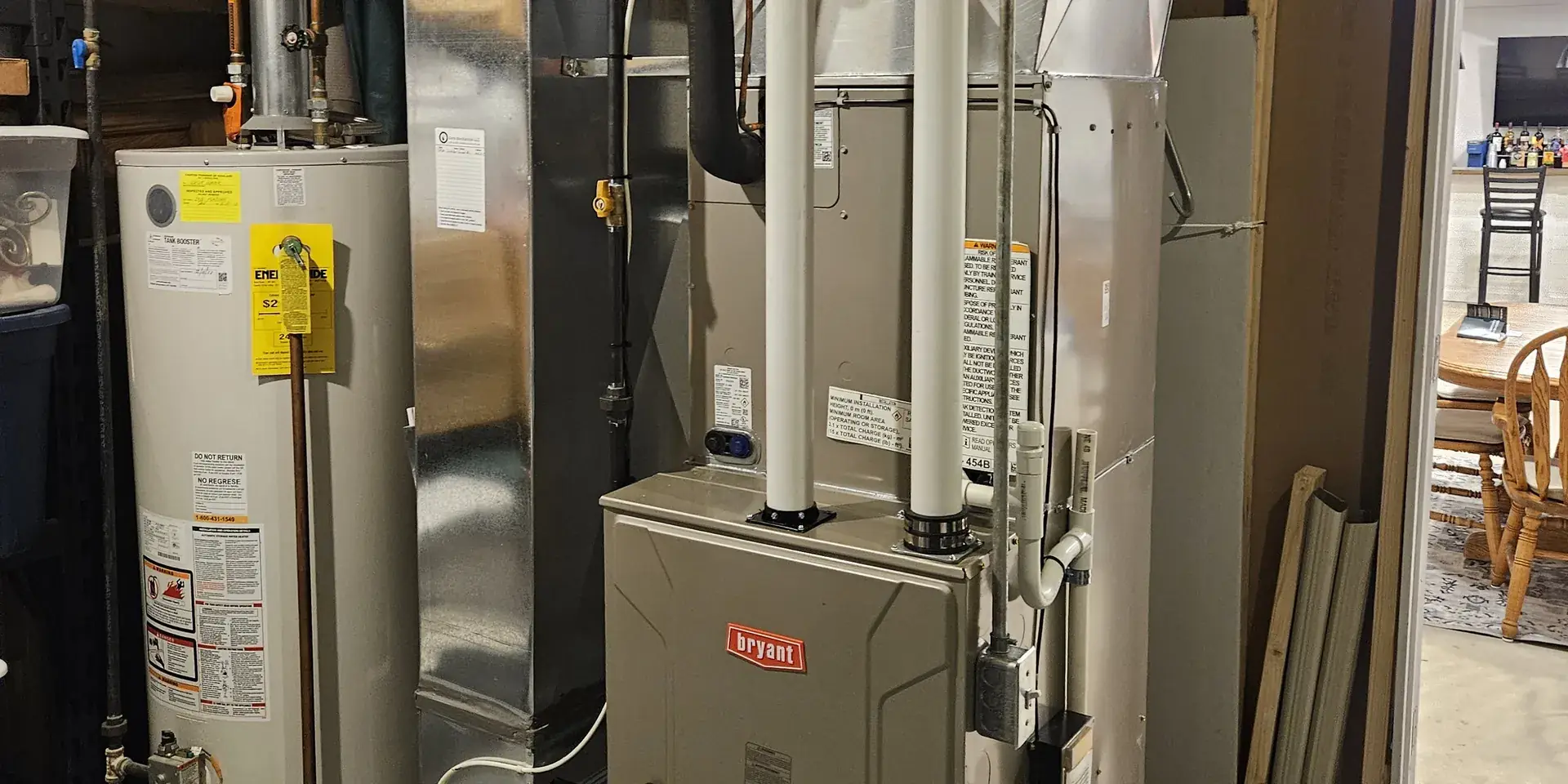
Furnace Repair in Waterford Township, Michigan
Thirty-four named lakes, and a great deal of year-round housing that started life as something people only used in July.
Quick answer
Kern Mechanical repairs furnaces throughout Waterford Township, from Drayton Plains and Clintonville to the lake neighborhoods and Waterford Village. Call 248-714-6563. No-heat calls go to the front of the queue during business hours, Monday through Saturday, 7:30 AM to 5:00 PM. We service every major furnace brand, and you will have the diagnosis and the price before any work starts.
The largest community on our map, and the wettest
Roughly 70,500 people live in Waterford Township, spread across some 34 named lakes at about 2,230 people per square mile. That makes it both the biggest and the densest community we serve, and the water is not incidental to it — the township was organized around the lakes rather than the lakes being features of the township.
Settlement here began in 1818 on Silver Lake. When the railway arrived in 1851 the character of the place changed: Waterford became a summer resort destination for Detroit families, and remained one for the better part of a century. That single fact explains more about the heating equipment in this township than anything else we could tell you.
The cottage conversion problem
A resort era leaves resort housing behind. A great deal of Waterford's year-round stock began as a summer cottage on a lake lot, and was converted to full-time living somewhere between the 1950s and the 1970s. Those conversions were practical projects. Space was found for a furnace wherever space existed, which in practice meant a closet, a corner or a shallow crawlspace, and the distribution was run through whatever cavities the house already had.
You can usually recognize a conversion from the inside. The mechanical space is tight enough that servicing means working at an angle. There is one return where a house that size ought to have two or three. The duct trunk changes direction more often than a purpose-built system would need to, and at least one run crosses ground that nobody ever intended to heat.
That history is not a problem to be embarrassed about. These are solid houses. But it does mean the furnace in them has been asked to do a job under conditions it was not designed around, and diagnosing one properly means reading the house as well as the equipment.
Humidity and corrosion on lakefront mechanicals
Homes on the water live with moisture that inland homes never see in the same concentration. Crawlspaces stay damp, basements hold humidity through the shoulder seasons, and mechanical equipment sits in that air for its entire working life.
The effect is selective rather than general. Cabinets pick up surface rust that usually means very little. What matters is the corrosion that develops on heat exchangers and on flue and vent components, because those are precisely the parts whose integrity keeps combustion gases separate from the air moving through your house. Corrosion there is a safety finding, not a cosmetic one, and it also shortens the practical life of equipment that would otherwise still have years in it.
On a lakefront house we inspect those components deliberately instead of glancing at the outside of the cabinet and moving on. It is the single most useful difference between a real diagnostic and a quick look.
Undersized return air and why the furnace short cycles
Of all the complaints we answer in this township, the most commonly misdiagnosed is a furnace that starts, runs briefly, shuts off, and starts again a few minutes later without ever satisfying the thermostat.
People assume the furnace is failing or oversized. Often what is actually happening is that the system cannot get enough air back to itself. A furnace has to move a specific volume of air across its heat exchanger to carry the heat away. If the returns are too small — which is routine in a converted cottage, where returns were added last and smallest — the air in the plenum gets hotter than the design allows, the high limit switch does its job and cuts the burner, the blower runs on to clear the heat, and the whole sequence begins again.
That cycle is hard on the equipment, wasteful in fuel and unpleasant to live with, and it will do exactly the same thing to a brand-new furnace installed on the same ductwork. It is also measurable, which is the important part: we can show you the temperature rise against what the manufacturer specifies, and correcting the return capacity fixes the behavior for good.
Waterford is not one neighborhood
It is worth saying plainly, because it changes what we bring: the housing stock differs substantially across the township, and treating Waterford as a single place produces bad guesses.
Drayton Plains and Clintonville are established, settled areas with their own histories rather than extensions of anywhere else. Four Towns sits where several communities meet and carries a mixture that reflects it. Elizabeth Lake is lake housing in the fullest sense, with the conversions and the moisture that go with it. Waterford Village is the older core, and the equipment there tends to have been replaced into spaces designed for something earlier.
Tell us which of those you are in when you call and we arrive with the right expectations rather than forming them in your hallway.
What we check
Every visit begins with verifying the complaint rather than accepting the theory. We confirm that the thermostat is calling for heat and that the safety circuit is closed, then watch a full ignition sequence and read what the burner actually does. We test the flame sensor, the limit switch and the pressure switch, because each of those protects the system and each of them shuts it down for a different reason.
Then the house. Filter condition, return capacity, temperature rise measured against the manufacturer's specification, blower performance, condensate path and trap on a high-efficiency unit, and the venting run from the cabinet out through the wall or roof. On lake properties we pay particular attention to the flue components and the heat exchanger for the corrosion reasons above.
You hear the findings and the price before anything is taken apart, and nothing goes ahead without your approval.
Repair or replace
In a converted cottage the honest answer is more often repair than homeowners expect, because the constraint on comfort in those houses is usually the distribution rather than the furnace. Spending on equipment while the returns stay undersized buys a quieter version of the same disappointment. Correcting the airflow and keeping a sound furnace is frequently both the cheaper and the better outcome.
Replacement makes sense when the heat exchanger or the venting has corroded to the point where integrity is in question, when failures have turned into a pattern, or when the repair cost has climbed far enough that it stops being a repair decision. We tell you which of those we are looking at, and we tell you when the furnace deserves to stay.
Common furnace faults
Our main furnace repair page walks through the eight problems we see most.
Frequently Asked Questions
How can I tell whether my house was originally a summer cottage?
A few things give it away. The furnace is usually squeezed into a closet or a low crawlspace rather than a proper mechanical room, the returns are small or there is only one, the ceiling heights change between the original rooms and the additions, and heat reaches the newest rooms worst. None of it is a defect. It just explains the behavior you are seeing.
Does living on the water actually wear out a furnace faster?
It wears out particular parts faster. Sustained humidity accelerates corrosion on the heat exchanger and on flue and vent components, which are the pieces where corrosion matters most, because they are what separates combustion gases from the air you breathe. It is a reason to inspect those parts properly rather than glance at them.
My furnace turns on and off every few minutes. Is it too big?
Oversizing is one cause, but in Waterford the more common one is that the furnace cannot get enough air back to itself. Starved returns make the plenum overheat, the limit switch cuts the burner, the blower clears the heat, and the cycle repeats. Adding return capacity solves it. Replacing the furnace does not.
Do you work across the whole township or just near the lakes?
The whole township — Drayton Plains, Clintonville, Four Towns, Elizabeth Lake, Waterford Village and everywhere between them.
My furnace is in a crawlspace. Is that going to be a problem for you?
No. It takes longer to reach and it changes what we check, particularly the condensate route and the duct runs through unheated space, but the work is the same work.
How fast can you get out on a no-heat call?
No-heat calls go to the front of the queue. Call 248-714-6563 during business hours — Monday through Saturday, 7:30 AM to 5:00 PM.
Do you charge for a quote?
No. Quotes are always free, and you will have the price before anything starts.
Emergency service available
Heat out? Cooling down? Call us now.
Whether it is a planned replacement or an emergency HVAC repair, Kern Mechanical is available to handle all of your heating, cooling, and ventilation needs.