
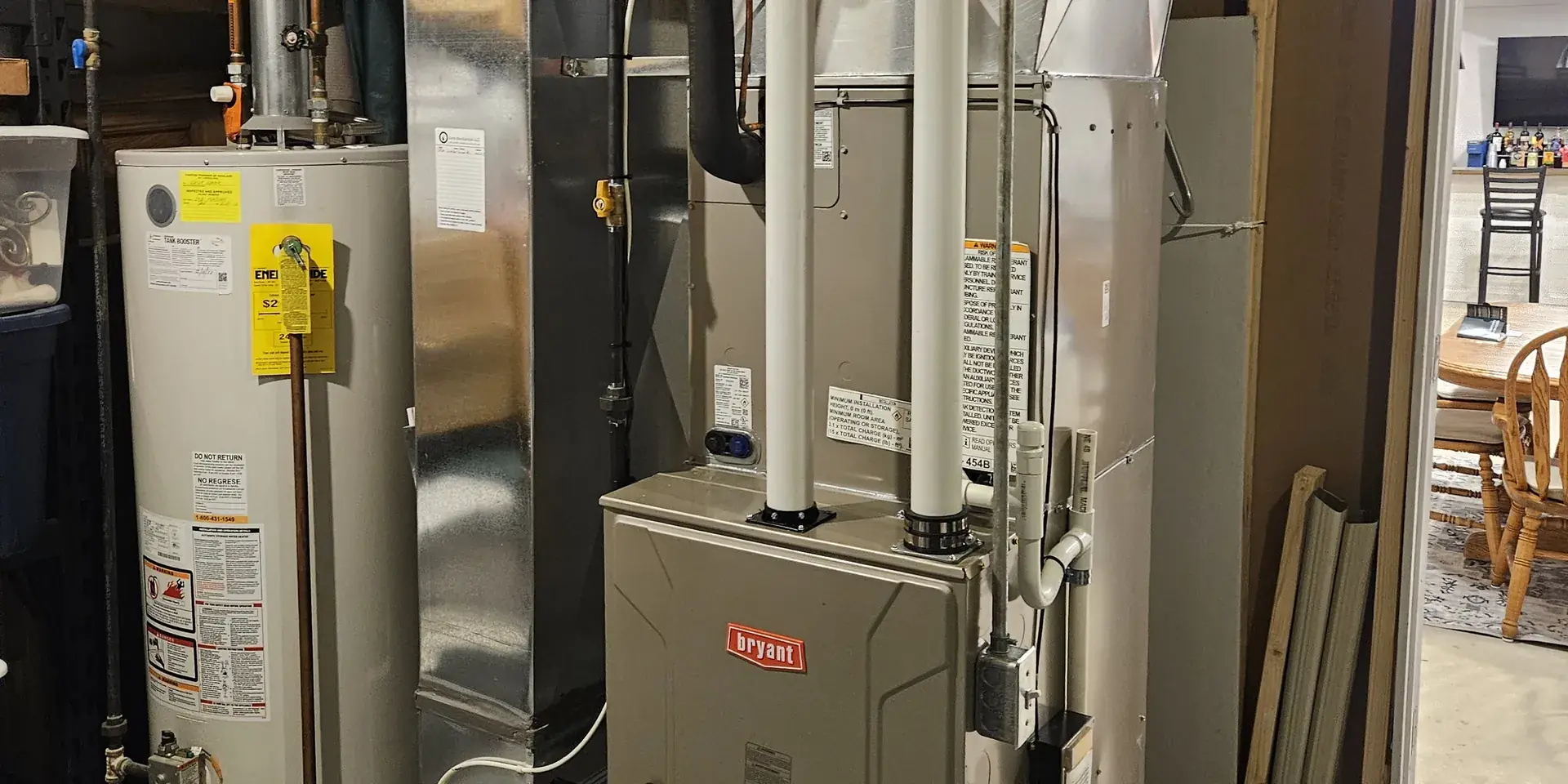
It always seems to happen on the first truly cold night. You turn the thermostat up, wait for the familiar rumble from the basement, and nothing happens. Or the blower kicks on and pushes air through the vents, but it is cold. Before you assume the worst, know that a large share of no-heat calls come down to a handful of simple causes, and several of them you can check in ten minutes without tools. This guide walks through those checks in order, explains what the furnace is telling you, and draws a clear line at the point where you should stop and call a technician.
Quick answer
Start with the simple things: confirm the thermostat is set to Heat and above room temperature, check that its batteries are good, make sure the furnace switch and breaker are on, replace a dirty filter, and confirm the furnace door panel is fully closed. If the furnace still will not light, or it runs but blows cold air, the cause is usually a dirty flame sensor, a failed igniter, a blocked condensate drain, or a tripped safety switch, and that is a job for a technician.
Step 1: Rule out the thermostat
It sounds obvious, but the thermostat is the first place to look, and it catches more people than you might expect. Make sure it is set to Heat, not Cool or Off, and that the setpoint is a few degrees above the current room temperature. If the fan setting is on On rather than Auto, the blower will run constantly, pushing room-temperature air through the vents between heating cycles. That feels like cold air and is one of the most common reasons people think their furnace is broken when it is not.
If the screen is blank or dim, replace the batteries. Many thermostats run on batteries even when they are wired to the furnace, and a weak battery can drop the call for heat without any warning. Smart thermostats can also lose their Wi-Fi connection or update overnight and come back with different settings, so open the app or the menu and confirm the schedule has not changed.
Step 2: Check power to the furnace
A furnace needs electricity to run its igniter, controls, and blower, even when it burns natural gas. Look for a light switch on or near the furnace. It is a service switch, and it is very easy for someone to flip it off while reaching for a light in the basement. Then check your electrical panel for a tripped breaker labeled furnace or HVAC. If the breaker has tripped, reset it once. If it trips again, leave it off and call, because a breaker that will not hold is pointing to an electrical fault inside the equipment.
Step 3: Look at the filter
A badly clogged filter starves the furnace of air. The heat exchanger gets too hot, a high-limit safety switch shuts the burners off, and the blower keeps running to cool things down. From the living room, that looks exactly like a furnace blowing cold air. If the filter is gray and caked, replace it and give the furnace a few minutes to reset. ENERGY STAR recommends checking the filter every month and changing it at least every three months, and in a Michigan winter, when the furnace runs for hours a day, many homes need it sooner than that.
Step 4: Make sure the door panel is seated
Most furnaces have a safety switch behind the lower blower door. If that panel is even slightly out of place after a filter change, the furnace will not run at all. Press the panel firmly into place and make sure every tab and screw is where it belongs.
Step 5: Read the status light
Most modern furnaces have a small window on the lower panel with a blinking LED. That light is a diagnostic code. A sticker on the inside of the door explains what each pattern means. Write down the number of flashes before you turn anything off, because cutting power often clears the code. Even if you do not act on it yourself, telling a technician the code on the phone helps them arrive with the right part.
Why a furnace runs but blows cold air
If the blower runs but the air is cold, the burners are either not lighting or are lighting and then shutting off. Here are the usual reasons, in roughly the order we find them.
A dirty flame sensor. The flame sensor is a thin metal rod that sits in the burner flame and confirms to the control board that gas is actually burning. Over time it builds up a coating, the board can no longer read the flame, and it shuts off the gas within a few seconds as a safety measure. You will often hear the furnace light, run briefly, and go out, repeating several times before it locks out. A technician cleans or replaces the sensor, and the problem is gone.
A failed hot surface igniter. Most furnaces built in the last 25 years light their burners with a hot surface igniter, a small ceramic element that glows bright orange. These wear out and eventually crack. When the igniter fails, the furnace goes through its startup sequence, never lights, and eventually locks out.
A blocked condensate drain on a high-efficiency furnace. High-efficiency furnaces produce water as they run. If the drain line or trap clogs, or freezes where it runs through a cold space, a pressure switch shuts the furnace down to keep water out of the combustion system. This is one of the most common winter no-heat calls we see. If you notice water around the base of the furnace as well, read our guide on why a furnace leaks water.
Blocked intake or exhaust pipes. High-efficiency furnaces draw combustion air and vent exhaust through PVC pipes, usually out a side wall. Heavy snow, drifting, ice, or a wasp nest from the summer can block them. Look outside where the two white pipes exit the house. If they are buried in snow, clear them gently by hand, and keep the area clear for the rest of the winter.
A tripped high-limit or rollout switch. These safety switches shut down the burners when something is wrong, such as overheating or flame rolling out of the burner area. Some reset themselves and some must be reset by hand. A rollout switch that trips is a warning sign about venting or the heat exchanger and should always be diagnosed by a technician rather than simply reset.
Gas supply problems. If other gas appliances in the house are not working either, the problem may be with the gas supply rather than the furnace. Contact your gas utility.
Older furnaces with a standing pilot
If your furnace has a standing pilot light, a small flame that burns all the time, a pilot that has gone out is a common reason for no heat. Many furnaces of that age have relighting instructions on a label inside the door. If you are not comfortable following them exactly, do not try. And keep in mind that a furnace old enough to have a standing pilot is well past the typical 15-to-20-year lifespan for equipment here. If you are weighing your options, our guide to repairing or replacing a furnace walks through how we think about that decision.
When to stop and call
Some situations should never be handled as a do-it-yourself project. Stop and call a professional if:
You smell gas. Leave the house right away, do not touch light switches, and call your gas utility or 911 from outside.
Your carbon monoxide alarm sounds. Get everyone outside and call 911. The EPA explains why CO is so dangerous: it is odorless and the early symptoms feel like the flu.
The breaker trips a second time.
The furnace lights and shuts off repeatedly, or you see scorching, soot, or melted wiring.
You have worked through the checks above and the furnace still will not heat.
Do not bypass a safety switch, tape down the door switch, or keep resetting a furnace that keeps locking out. Those switches are there because something is wrong.
Keeping the house safe while you wait
If the furnace is down in real cold, a few simple steps buy time. Keep interior doors open so the heat you have spreads evenly. Open cabinet doors under sinks on exterior walls so warmer room air reaches the pipes. If you use a space heater, plug it directly into a wall outlet, keep it three feet from anything that can burn, and never leave it running unattended or overnight. Never use a gas oven, grill, or generator to heat the house.
How to avoid the no-heat call next winter
Most of the failures above are caught during a fall tune-up. A technician cleans the flame sensor, tests the igniter, flushes the condensate trap and drain, checks the safety switches, and inspects the heat exchanger and venting before the season starts. Combine that with a filter you actually change, intake and exhaust pipes you keep clear of snow, and a working carbon monoxide alarm on every level of the house, and you have done most of what it takes to get through a Michigan winter without an emergency call.
Frequently Asked Questions
Why is my furnace running but blowing cold air?
The most common causes are the thermostat fan set to On instead of Auto, a clogged filter tripping the high-limit switch, a dirty flame sensor, a failed igniter, or a blocked condensate drain on a high-efficiency furnace. Start with the thermostat and filter, then call a technician if the air is still cold.
Can I reset my furnace myself?
You can safely turn the service switch off for about 30 seconds and back on, which restarts the control board and starts a new ignition attempt. If the furnace locks out again, stop and call for service rather than resetting it over and over.
How do I know if my furnace flame sensor is bad?
The classic sign is a furnace that lights, runs for a few seconds, then shuts off and tries again, often several times before locking out. The status light may also show a flame-sense code. Cleaning the sensor usually fixes it.
Why won't my furnace turn on after I changed the filter?
The blower door panel is most likely not fully seated, which keeps the door safety switch open. Press the panel firmly into place and confirm the filter is facing the right direction and fits the slot.
Should I call for emergency service if my furnace stops working at night?
If you smell gas or your CO alarm sounds, leave and call 911 or the gas utility right away. Otherwise, secure the house using the steps above and call first thing in the morning. Kern Mechanical prioritizes no-heat calls during business hours.
If you have worked through the checks and the house is still cold, call Kern Mechanical. We prioritize no-heat calls during business hours, Monday through Saturday, and we will tell you plainly whether you are looking at a quick fix or something bigger. Learn more about our furnace repair service or our full range of residential heating and cooling work, or request a free quote.
Free consultation
Talk to Kern Mechanical LLC
Our family-owned team handles residential, commercial, and industrial HVAC across Southeast Michigan. Quotes are always free.