
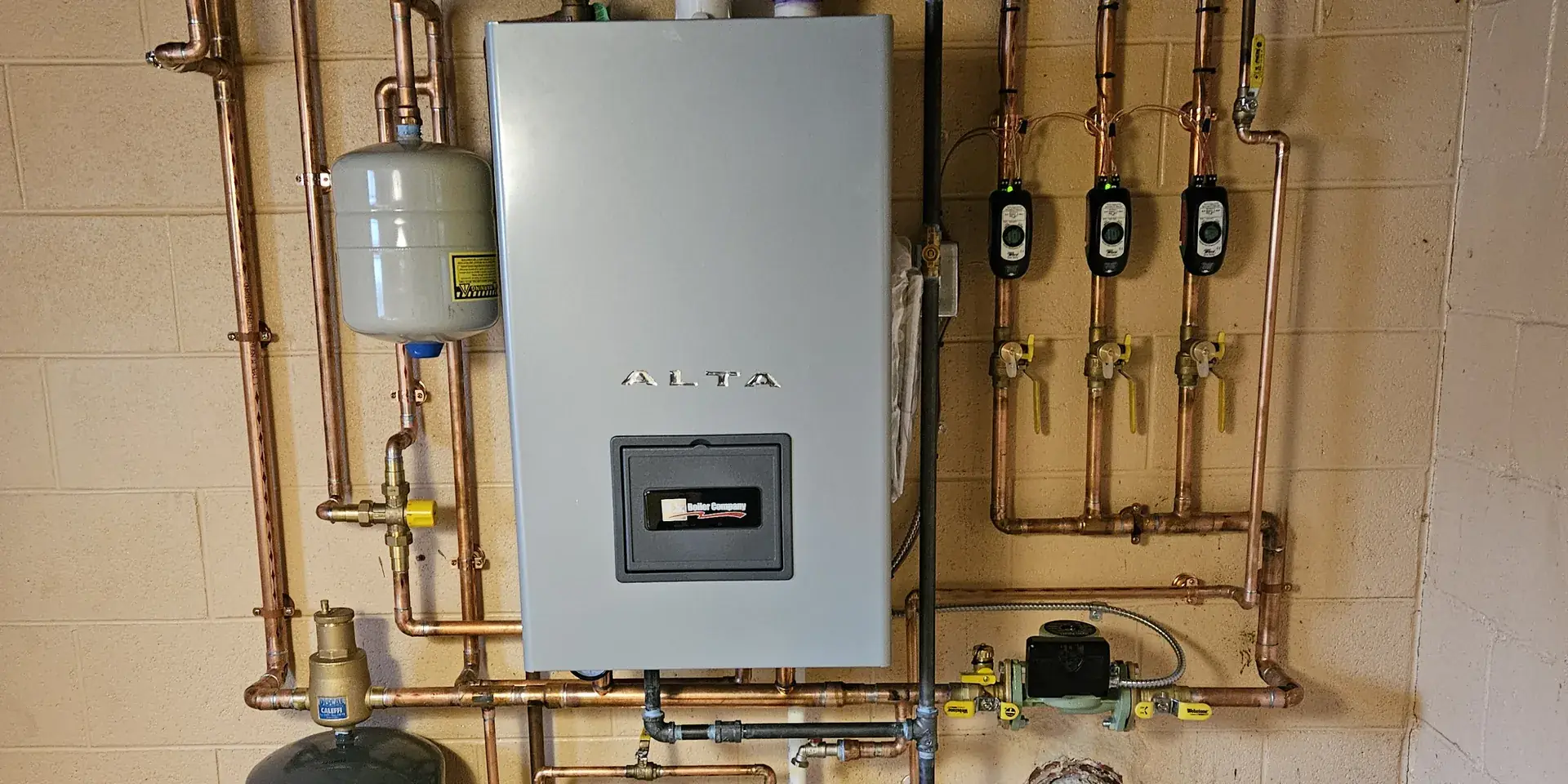
Most furnace decisions in Michigan are made under pressure. The house is cold, the technician has just delivered a repair estimate, and you have to decide whether to spend that money on a furnace that may be near the end of its life or put it toward a new one. We have helped families through that moment for decades. This guide lays out how we think about it so you can make the call with clear eyes, ideally before the furnace forces your hand.
Quick answer
Gas furnaces in Michigan last about 15 to 20 years. As a rule, repair a furnace under 10 years old unless the fix is unusually expensive, and lean toward replacement once it is past 15 years and facing a repair over $1,000, is needing service every winter, or has a cracked heat exchanger. Between those ages, compare the repair cost to the price of a new system and factor in how much you are overpaying in fuel each winter.
Start with age: how long a furnace really lasts here
A gas furnace in Southeast Michigan typically lasts 15 to 20 years. Ours is a heavy heating climate, with the furnace running from October into April and hard through December, January, and February, so equipment here logs more hours than the same unit would in a milder state. A furnace that was maintained every fall and had its filter changed regularly tends to reach the upper end of that range. One that was ignored often does not.
If you do not know how old your furnace is, look for a manufacture date on the rating plate inside the cabinet door, or note the serial number and we can decode it. Age alone does not condemn a furnace, but it changes how you should read every other signal.
The repair-cost math
The rule most contractors use, and the one we find holds up, goes like this. If the furnace is under 10 years old and the repair is under roughly $800, repair it. If it is over 15 years old and the repair is over $1,000, replacement almost always makes more sense, because you are putting a large sum into equipment that is likely to need something else soon. Between 10 and 15 years, with repairs in the $500 to $1,200 range, look at the other factors below.
A useful check is to multiply the furnace's age by the repair cost. When that number passes $5,000, replacement usually wins. A $600 repair on a 6-year-old furnace is $3,600, an easy yes. The same $600 repair on a 17-year-old furnace is $10,200, and it is time to have the replacement conversation.
Certain repairs settle the question on their own. A cracked heat exchanger is the big one: it is a safety issue because it can allow combustion gases into your home's air, and the repair is expensive enough that on any furnace past its first decade, replacement is the answer. A failed control board or blower motor on an old unit is another common point where the repair cost approaches a meaningful share of a new system.
Signals beyond the estimate
Frequency of service matters as much as the size of any one bill. If you are calling for a repair every winter, the individual fixes may be affordable but the pattern tells you the furnace is worn out. Rising gas bills without a change in your usage point to a furnace losing efficiency as it ages. Uneven heating, short cycling, a burner flame that has turned yellow instead of blue, and rust or soot around the unit are all signs we take seriously.
Comfort counts too. A furnace that struggles to hold temperature on the coldest nights, or that leaves the upstairs cold, is doing its job poorly even if it has not failed. A properly sized new system fixes problems that repairs never will.
What a new furnace costs in Southeast Michigan in 2026
Installed costs depend on efficiency, staging, and the condition of your ductwork and venting. In our area, a standard 80% AFUE single-stage furnace generally runs in the $3,200 to $5,500 range installed. A mid-efficiency 92% to 95% two-stage furnace is typically $4,500 to $7,200. A high-efficiency 96% to 98% modulating furnace runs $6,000 to $9,500 or more. Those are ranges, not quotes; the right number for your home depends on a load calculation and a look at what is already in your basement.
Efficiency is worth thinking about carefully in a climate like ours. Moving from an old 80% furnace to a 96% unit means roughly 16 cents more heat from every dollar of gas, and over a Michigan heating season that adds up. High-efficiency furnaces also vent through PVC pipe rather than a metal chimney, which sometimes adds installation work and sometimes solves a venting problem you did not know you had.
Rebates and incentives: what changed for 2026
Be careful with information you find online about furnace tax credits. The federal 25C Energy Efficient Home Improvement Credit, which offered up to $600 for a qualifying high-efficiency furnace, expired for equipment placed in service after December 31, 2025. If a furnace is installed in 2026, that credit does not apply.
What is still available are utility rebates. DTE Energy and Consumers Energy both offer rebates for qualifying high-efficiency furnaces, smart thermostats, and related upgrades, with amounts that vary by measure and are updated periodically. Michigan's income-qualified Home Energy Rebate programs can cover a significant share of a project for households under the income limits. We verify current program terms as part of every quote so the numbers you plan around are accurate.
If your furnace fails in the middle of winter
Call us. We offer emergency service, and our first priority is getting heat back into your home safely. We will tell you honestly whether a repair will hold or whether you would be spending money on borrowed time. If replacement is the right answer, we walk you through the options in plain language, without pressure, and we do not rush the work. A furnace is a fifteen-year decision, and it deserves a full consultation even when the house is cold.
Frequently Asked Questions
How long does a furnace last in Michigan?
Gas furnaces in Southeast Michigan typically last 15 to 20 years. Regular fall maintenance and filter changes push furnaces toward the longer end of that range, while neglected units often fail sooner because they run so many hours through our long heating season.
Is it worth repairing a 20-year-old furnace?
Rarely. At 20 years a furnace is past its expected life, its efficiency has declined, and other components are likely to fail soon after any repair. Unless the fix is very minor, that money is better put toward a new system that will heat more reliably and cost less to run.
What is the 50% rule for furnace replacement?
If a repair costs more than half the price of a comparable new furnace, replace it. A related check is to multiply the furnace's age by the repair cost: above $5,000, replacement usually makes more financial sense.
Can I still get a tax credit for a new furnace in 2026?
No. The federal 25C credit for high-efficiency furnaces expired for equipment placed in service after December 31, 2025. DTE Energy and Consumers Energy utility rebates and Michigan's income-qualified Home Energy Rebates may still be available; we confirm current terms with every quote.
How much does a new furnace cost installed in Southeast Michigan?
In 2026, a standard 80% AFUE furnace generally runs $3,200 to $5,500 installed, a mid-efficiency two-stage unit $4,500 to $7,200, and a high-efficiency modulating furnace $6,000 to $9,500 or more, depending on your home and existing ductwork and venting.
Should I replace my air conditioner at the same time as my furnace?
If your AC is also more than 12 to 15 years old, replacing both together usually saves on labor, ensures the indoor and outdoor equipment are matched for efficiency, and avoids a second disruption a year or two later. If the AC is newer, there is no need.
Whether you need a repair tonight or want to plan a replacement before next winter, Kern Mechanical is here to help. We are family-owned, licensed and insured, and we have served Milford, Highland, White Lake, Wixom, South Lyon, Brighton, Howell, and the surrounding communities for years. Quotes are always free, and so is our honest opinion.
Free consultation
Talk to Kern Mechanical LLC
Our family-owned team handles residential, commercial, and industrial HVAC across Southeast Michigan. Quotes are always free.