
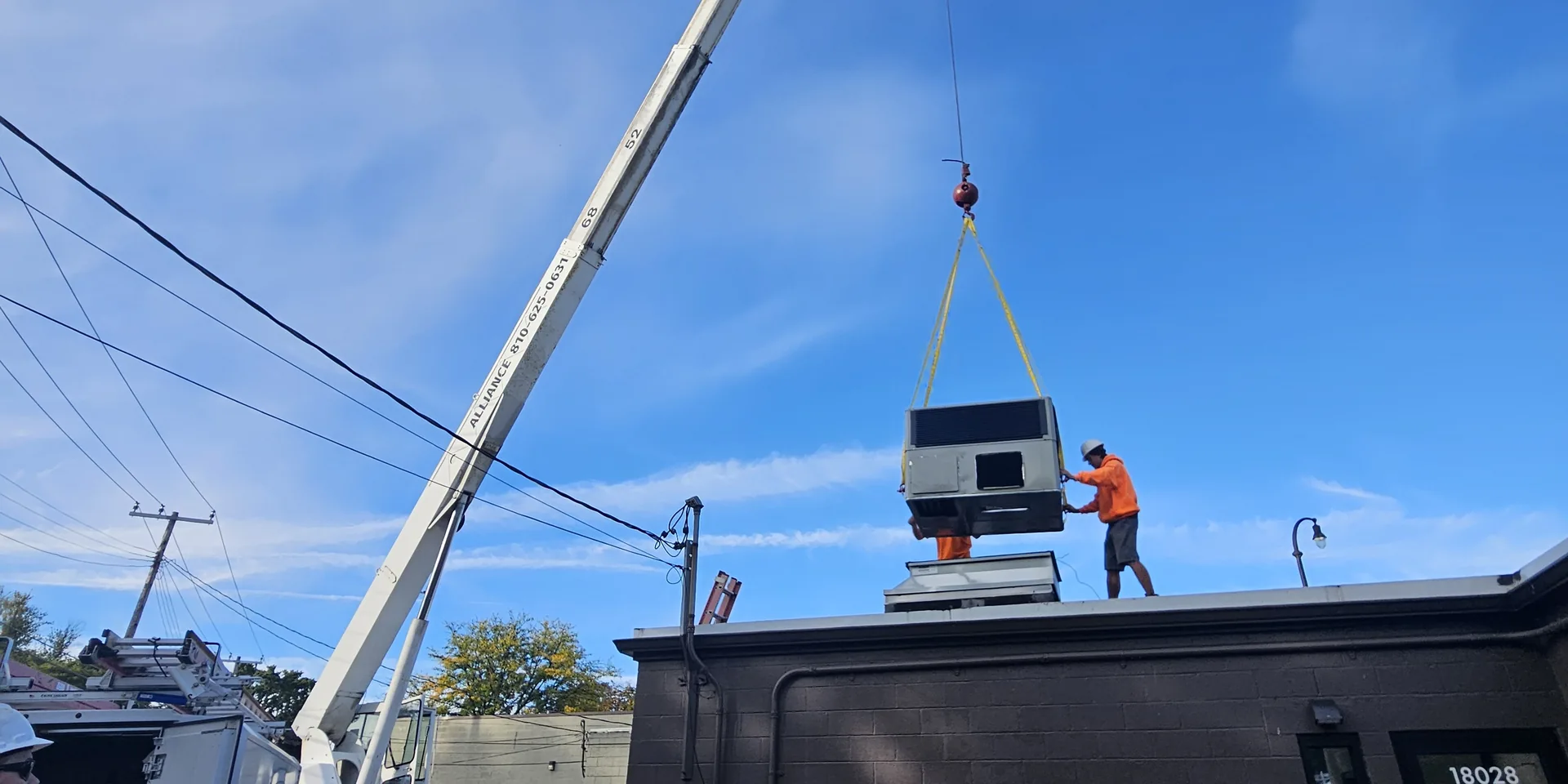
A rooftop unit is easy to forget. It sits out of sight, runs without complaint, and asks for nothing until the dining room hits 82 degrees on a Saturday in July or the sales floor is cold on Black Friday. We maintain rooftop units for restaurants, retail chains, medical offices, and multi-site operators across Southeast Michigan, and the pattern is always the same: the businesses that schedule maintenance have far fewer emergencies than the ones that call when something breaks. This guide covers what a rooftop unit needs, how often, and how to know when repairing one has stopped making sense.
Quick answer
Most commercial rooftop units should receive professional preventive maintenance at least twice a year, once before cooling season and once before heating season, with quarterly visits for restaurants and other high-demand spaces. Filters typically need changing every one to three months depending on the environment. A well-maintained RTU commonly lasts 15 to 20 years; one that is neglected often needs replacement in 10 to 12.
Why rooftop units fail more often than they should
Packaged rooftop units combine the compressor, condenser, evaporator, blower, and often gas heating in one cabinet on the roof, exposed to everything a Michigan year delivers: summer heat, freezing rain, snow load, and the pollen and cottonwood that clog condenser coils every spring. Inside a restaurant, they also fight kitchen grease that coats coils and filters. That combination of exposure and constant runtime is why most RTU failures trace back to the same handful of causes: dirty coils, clogged filters, worn belts, failing capacitors and contactors, low refrigerant from slow leaks, and controls or economizer dampers that drifted out of adjustment years ago.
None of those are dramatic. Each one raises energy use and strain a little, and left alone for a few seasons they add up to a compressor failure that could have been avoided for a fraction of the cost.
The maintenance schedule that works
For a typical retail or office space, two professional visits a year is the baseline. A spring visit prepares the cooling side: clean the condenser and evaporator coils, check refrigerant charge and pressures, test capacitors, contactors, and the compressor amp draw, inspect and tighten electrical connections, verify the condensate drain is clear, check belts and blower alignment, and confirm the economizer is bringing in outdoor air when it should and not when it should not. A fall visit prepares the heating side: inspect the heat exchanger, burners, igniter, and gas pressure, test the safety controls and limit switches, and check the flue.
Restaurants, gyms, and other high-load spaces are better served quarterly. Kitchen exhaust and make-up air systems put unusual stress on rooftop equipment, and grease-laden air fouls filters and coils quickly. Filter changes should happen every one to three months regardless of the professional schedule, and in a restaurant the shorter end is usually right. A clean filter is the single cheapest thing that protects a compressor.
Between visits, someone on your staff should know where the thermostat is, what a normal temperature looks like, and who to call. Catching a problem on a Tuesday afternoon is a service call. Catching it on a Saturday night is an emergency.
Repair or replace: reading the signs on a rooftop unit
Rooftop units in our climate commonly last 15 to 20 years with consistent maintenance, and closer to 10 to 12 without it. Age is the starting point, and the same logic we apply to a home furnace applies here: a repair on a unit under 10 years old is almost always worth it, and a major repair on a unit past 15 rarely is.
The signals that a unit is nearing the end are familiar. Repeated service calls on the same unit, rising energy costs that do not track with weather or occupancy, a major component failure such as a compressor or heat exchanger, and persistent comfort complaints from staff or customers that repairs do not resolve. When two or more of those show up together, the unit is telling you something.
There are also reasons to replace before failure. Older rooftop units are far less efficient than current equipment, and on a unit that runs most of the day, most days of the year, the energy savings from a modern high-efficiency replacement can be substantial. New units also use R-454B refrigerant rather than R-410A; as R-410A becomes more expensive for servicing older equipment, refrigerant-related repairs on aging units get harder to justify. And a planned replacement in April on your schedule costs less and disrupts less than an emergency replacement in July with a crane rental on a rush basis.
Planning across multiple locations
If you operate several sites, the most valuable thing you can have is an accurate inventory: every rooftop unit, its age, tonnage, refrigerant type, service history, and known issues. Most multi-site operators we start working with do not have this, and it is the first thing we build. With it, you can budget replacements a year or two out instead of reacting, prioritize the units most likely to fail, and negotiate equipment purchases in groups rather than one crisis at a time.
A single mechanical contractor covering all of your Southeast Michigan locations also means consistent standards, one point of contact, and technicians who already know your buildings. When a unit does go down, the call is shorter because we already have the history.
What a good maintenance agreement should include
Look for a written scope that lists the specific checks performed on each visit, not just "tune-up." Look for documentation after every visit with readings, findings, and recommendations, so you have a record and can see trends. Look for priority scheduling for emergency calls, because when your dining room is hot, being first in line matters. And look for a contractor who will tell you when a unit is not worth another repair, even when the repair would be easy money.
That last one is how we operate. We would rather help you plan a replacement on your terms than keep billing you for repairs on equipment we know is finished.
Frequently Asked Questions
How often should commercial HVAC be serviced?
At least twice a year for most commercial spaces, once before cooling season and once before heating season. Restaurants, fitness facilities, and other high-demand environments are better served with quarterly visits. Filters should be changed every one to three months regardless.
How long do commercial rooftop units last?
With consistent preventive maintenance, packaged rooftop units in Michigan commonly last 15 to 20 years. Neglected units often need replacement in 10 to 12 years, usually after a compressor failure that maintenance would likely have prevented.
What is included in rooftop unit maintenance?
A thorough visit includes cleaning condenser and evaporator coils, checking refrigerant charge, testing electrical components and compressor amp draw, clearing the condensate drain, inspecting belts and the blower, verifying economizer operation, and on the heating side inspecting the heat exchanger, burners, igniter, gas pressure, and safety controls.
Should I repair or replace a 15-year-old rooftop unit?
Lean toward replacement if the repair is major, the unit has needed repeated service, energy costs have climbed, or comfort complaints persist. A planned replacement is cheaper and less disruptive than an emergency one, and new equipment is significantly more efficient.
Do restaurants need different HVAC maintenance than retail stores?
Yes. Kitchen exhaust, make-up air, and grease-laden air put far more stress on rooftop equipment and foul filters and coils quickly. Restaurants generally need quarterly professional maintenance and monthly filter changes, compared with twice-yearly service for most retail spaces.
Does Kern Mechanical service multiple locations?
Yes. We maintain rooftop units for restaurants, retail chains, and multi-site operators across Oakland, Livingston, Genesee, Macomb, Wayne, and Washtenaw counties, and we build a full equipment inventory for each client so replacements can be planned rather than reacted to.
If your rooftop units are due for maintenance, or you are not sure when they were last serviced, Kern Mechanical can help. We are a family-owned, licensed and insured mechanical contractor with over 60 years of combined experience serving commercial and industrial clients across Southeast Michigan, and emergency service is available when you need it. Quotes and consultations are always free.
Free consultation
Talk to Kern Mechanical LLC
Our family-owned team handles residential, commercial, and industrial HVAC across Southeast Michigan. Quotes are always free.